
First, let us make one important point absolutely clear: the new eviction moratorium under Article 2 of RDL 29/2026 does not apply to mortgage foreclosure proceedings (ejecución hipotecaria). This interpretation has now been explicitly confirmed by the unified judicial criteria adopted by the Barcelona Court of First Instance. Mortgage foreclosure remains the legal backbone of Indemo's Discounted Debt recovery and monetisation model.
Equally importantly, taking ownership of the property, obtaining possession and subsequently selling it is only one of six potential monetary exit scenarios within our product — not the entire recovery model. Professional NPL servicing creates multiple opportunities to monetise an asset throughout its recovery lifecycle, often long before taking ownership of the underlying property becomes necessary.
The availability and attractiveness of these six exit opportunities depend on the circumstances of each individual case, its judicial progress, and the legal, negotiation and commercial work performed by the servicing company. Our product model is designed to actively manage these opportunities and pursue the most economically attractive risk-adjusted exit for investors, balancing potential returns, time, costs and execution risks.
In other words, the existence of multiple exit strategies is not a workaround for the new eviction moratorium — which does not apply to mortgage foreclosure proceedings — but an additional strength of Indemo's Discounted Debt product.
Here is how these six exit opportunities emerge and evolve throughout the NPL recovery lifecycle.
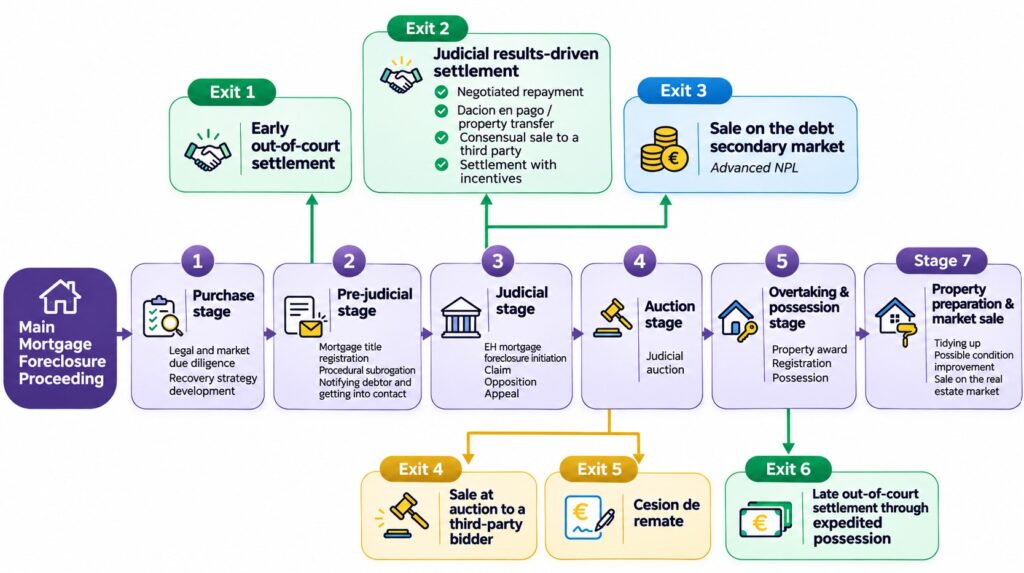
It all starts before the debt is purchased
When our debt suppliers consider purchasing an individual mortgage NPL, the process begins with detailed Legal Due Diligence (LDD).
The legal team and servicing company analyse the underlying mortgage documentation, outstanding claim, existing judicial proceedings, collateral value, property occupancy, potential vulnerability risks, and other circumstances that may influence recovery.
At this stage, they already begin developing an individual recovery strategy.
This includes identifying which legal enforcement procedure should be initiated or continued, what opportunities exist for an out-of-court settlement, and what potential economic proposal could be offered to the debtor.
Each acquisition is also tested against the product's qualifying criteria and financial model, including potential recovery amounts, legal costs, expected duration, and downside scenarios.
As we have previously explained, only approximately 10% of the opportunities reviewed by our partners ultimately proceed to acquisition.
This selective approach is important: successful NPL investment begins not with aggressive debt collection, but with disciplined acquisition and realistic recovery planning.
What happens immediately after acquisition?
Once a mortgage debt has been acquired, the servicing company begins several workstreams, often in parallel.
First, the legal team prepares the documentation required to register the assignment of the mortgage-secured claim in the Spanish Property Registry (Registro de la Propiedad).
Where judicial proceedings have already been initiated by the previous creditor, the lawyers also arrange the necessary procedural succession (sucesión procesal), enabling the new creditor to be formally recognised in the existing case and exercise its procedural rights.
This allows the legal representatives to obtain and review the judicial case file, access relevant procedural documents, and continue the appropriate legal recovery strategy.
At the same time, the debtor is notified of the change of creditor, provided with the relevant information regarding the claim, and invited to contact the new creditor to discuss the outstanding obligations and potential solutions.
In parallel, the out-of-court servicing team begins its own work.
Depending on the circumstances, this may involve contacting the debtor, authorised representatives, or legal successors, visiting the property where appropriate, verifying its occupancy and condition, and exploring opportunities for a voluntary agreement.
These activities are not merely administrative preparations.
They are the beginning of an active recovery strategy in which legal enforcement and voluntary negotiations work alongside one another.
The first exit opportunity: Early out-of-court settlement
One of the important economic advantages of acquiring mortgage debt at a discount is that the creditor does not necessarily need to recover the entire contractual outstanding balance to achieve a successful investment outcome.
For example, a mortgage claim may have a significantly higher outstanding balance than the price at which it was acquired.
This creates an economic margin that can be used to negotiate a mutually acceptable solution.
Depending on the specific case, our servicing partners may be able to offer partial debt forgiveness, financial incentives for voluntary settlement, assistance with relocation, or other arrangements that facilitate a resolution.
The objective is not necessarily to pursue the maximum possible contractual claim at any cost.
The objective is to achieve an economically sound recovery that meets the investment's target return while resolving the underlying debt responsibly.
For the debtor, such an agreement may provide an opportunity to resolve a difficult financial situation, reduce outstanding obligations, and avoid further litigation.
For investors, an agreement can significantly shorten the recovery period and reduce legal, administrative, and property-related costs.
Some cases can therefore reach a successful settlement relatively early in the servicing process, without requiring the full mortgage foreclosure lifecycle.
How judicial progress creates new opportunities for settlement
Not every debtor is willing to reach an agreement at the beginning of the recovery process.
In some cases, debtors prefer to postpone a decision, particularly while judicial proceedings remain ongoing and they can continue occupying and using the property.
They may also exercise their procedural rights to oppose the foreclosure claim or, where permitted, appeal a judicial decision.
These procedures naturally take time.
However, as the proceedings advance, the economic and legal circumstances of the case may change.
Once the opposition stage has been resolved and any applicable appeals have been completed, the debtor may face a much clearer prospect of the property being sold through a judicial auction.
At the same time, depending on the contractual and legal circumstances, interest may continue to accrue and recoverable legal expenses may increase the total amount owed.
This can change the debtor's motivation to negotiate.
There are two particularly important situations.
When the outstanding debt is lower than the property's value
The debtor risks losing ownership of a property that may have a market value higher than the outstanding mortgage debt.
This creates an incentive to cooperate with the creditor and potentially preserve more economic value through a consensual transaction.
When the outstanding debt is equal to or higher than the property's value
The debtor may face a different concern.
The sale of the mortgaged property may not fully satisfy the outstanding claim.
Depending on the circumstances, a residual debt may remain, potentially exposing the debtor to further recovery actions.
In this scenario, a settlement offering full and final resolution of the debt, including forgiveness of any agreed residual balance, may become particularly attractive.
From our servicing partners' experience, the later stages of mortgage foreclosure — particularly after significant procedural objections have been resolved and an auction becomes increasingly likely — can create some of the strongest opportunities for negotiated settlements.
At this point, the debtor understands that the legal process is advancing towards an enforceable outcome, while the creditor still has economic flexibility to offer an alternative.
What can such a settlement look like?
There are several possible structures.
Negotiated monetary repayment. The debtor, or a third party acting on their behalf, repays an agreed amount in exchange for full or partial settlement of the claim, as specified in the agreement.
Transfer of the mortgaged property in settlement of the debt. The debtor voluntarily transfers ownership of the property to the creditor under a negotiated debt settlement arrangement, commonly known in Spain as dación en pago. The creditor may subsequently monetise the property through a sale.
Voluntary sale of the property to a third party. The debtor cooperates in selling the property on the open real estate market. The creditor agrees to release the mortgage against an agreed allocation of the sale proceeds towards satisfaction of the outstanding claim.
Settlement involving additional financial incentives. Depending on the circumstances, the creditor may agree to forgive part of the outstanding debt, provide monetary compensation, or support the debtor's relocation to alternative accommodation.
The important principle is that these are not isolated legal mechanisms.
They are commercial solutions made possible by the combination of an enforceable mortgage claim, progress through judicial proceedings, and the economic flexibility created by purchasing the debt at a discount.
Another exit before the auction: Selling the NPL on the secondary debt market
There is another important recovery strategy that should not be overlooked: the sale of the mortgage claim itself to another professional investor before the judicial auction takes place.
Spain has an established secondary market for distressed mortgage debt, where institutional investors and specialised asset buyers acquire individual claims and portfolios at different stages of their legal recovery lifecycle.
Importantly, the value of an NPL is not static.
When a mortgage claim is initially acquired, its valuation reflects a certain level of legal uncertainty, expected recovery duration, and potential enforcement risks.
However, as the legal proceedings progress, some of these uncertainties may be substantially reduced.
For example, important milestones such as the judicial determination or confirmation of the enforceable debt amount, the successful dismissal of the debtor's opposition, or a favourable appellate decision can significantly strengthen the creditor's legal position.
Each of these developments may bring the case closer to the auction stage and make the expected recovery outcome more predictable.
As legal uncertainty decreases and the claim advances through important procedural milestones, its commercial value and attractiveness to other professional investors can increase substantially.
This creates another opportunity for the servicing company to monetise the investment.
Rather than continuing through the remaining stages of mortgage foreclosure, the creditor may decide to sell the claim to another institutional or professional buyer at a price reflecting the legal progress already achieved.
For the purchaser, such an asset may be attractive because part of the legal process has already been completed and certain recovery risks have been resolved.
For the original creditor and Indemo investors, this may provide an opportunity to realise a return and exit the investment without waiting for an auction, taking ownership of the underlying property, or obtaining possession.
This is another example of how professional legal servicing can create tangible economic value even before the underlying mortgage claim has been fully recovered.
In other words, the progress achieved by the legal team is not merely a procedural formality. It can directly improve the commercial position of the asset and open an additional monetary exit opportunity.
Judicial auction: A new stage, new monetisation opportunities
If the parties do not reach a settlement and the creditor decides not to sell the NPL on the secondary market, the mortgage foreclosure process may eventually proceed to a judicial auction.
This represents another significant recovery milestone and opens additional opportunities for a monetary exit.
One important characteristic of the Spanish auction system is its accessibility.
Unlike the institutional NPL market, which is largely driven by specialised debt investors, banks, funds, and professional servicing companies, judicial property auctions are open to a much broader pool of potential buyers.
Both professional real estate investors and private individuals may participate, provided they meet the applicable registration, deposit, and bidding requirements.
Spanish judicial auctions are conducted electronically through the official auction system, making them accessible to eligible participants beyond the traditional institutional distressed debt market.
This broader buyer base can create significant commercial interest, particularly for properties with sufficient value.
How the creditor approaches the auction
The creditor and servicing company assess the likely auction outcome well before bidding begins.
For some properties, the most attractive strategy is to achieve a cash recovery through a successful sale to an independent buyer.
For other properties, particularly where there is meaningful value in the underlying collateral, it may be economically preferable for the creditor to participate in the auction and seek an award of the property, subject to the applicable procedural rules.
This decision depends on multiple factors, including the outstanding debt, estimated market value, auction conditions, expected real estate resale price, taxation, possession status, and the additional time and costs required to complete the recovery.
The auction is therefore not simply the final step of a legal procedure. It is another point at which the servicing company actively evaluates the most efficient route to monetising the asset.
Cesión de remate: Selling the right to acquire the property
An important mechanism available in Spanish enforcement proceedings is cesión de remate — the transfer of auction award rights to a third party.
Where the creditor has obtained an auction position eligible for such a transfer, it may be possible to assign the right to acquire the property to another buyer, in accordance with the procedural requirements and before the relevant adjudication decree is issued.
This creates an additional commercial exit opportunity.
Instead of proceeding with registration of ownership, obtaining possession, and subsequently selling the property on the open market, the creditor can monetise its auction position through an agreement with a third-party investor.
There is a specialised segment of the Spanish distressed real estate market focused on acquiring these rights.
Such buyers typically have the expertise, capital, and operational infrastructure required to complete property acquisition, possession, and eventual resale.
For the creditor, the attraction is clear: an opportunity to convert a judicial recovery position into cash without necessarily going through the full property ownership and commercialisation process.
The availability and economics of such a transaction depend on the specific auction outcome, procedural requirements, and buyer demand.
Taking ownership of the property: Two possible routes to possession
If the creditor decides to acquire the property rather than transfer the auction rights to another investor, the process moves towards formal adjudication.
Once the relevant auction conditions have been satisfied, the judicial authority issues the property award decree (decreto de adjudicación), confirming the legally approved transfer of the property.
The creditor can then pursue registration of ownership in the Property Registry and the steps necessary to obtain possession.
At this stage, two further routes are particularly relevant.
Formal registration and judicial delivery of possession
Following the award decree, the new owner may need to complete registration in the Property Registry and, where the property remains occupied, use the applicable judicial procedure to obtain possession.
It was precisely at this stage — obtaining possession of a property following mortgage foreclosure — that the potential application of the new RDL 29/2026 eviction moratorium raised the most questions among participants in the mortgage debt market.
Would the new eviction moratorium also suspend the delivery of possession following a mortgage foreclosure, potentially delaying the final commercialisation of the property?
The [Barcelona judges' agreement] provides an important clarification: mortgage foreclosure proceedings are excluded from the new Article 2 moratorium, which applies to the specifically identified categories of proceedings rather than to mortgage foreclosure as such.
This supports the view that the new moratorium should not automatically extend the recovery process simply because a mortgage creditor has obtained an award of the underlying property.
Voluntary agreement on vacant possession
There is also another possibility, one that professional servicing companies actively explore.
Even after the creditor has obtained a judicial award of the property, it may still be possible to reach a voluntary agreement with the former owner or lawful occupant regarding the delivery of vacant possession.
At this stage, the situation may be clearer to all parties.
The mortgage foreclosure has resulted in the transfer of ownership, and the remaining question concerns the practical handover of the property.
Rather than waiting for a judicial possession procedure, the servicing company may negotiate a voluntary handover.
Depending on the circumstances, this could involve an agreed date for vacating and delivering the property, waiver or settlement of an eligible remaining debt balance, financial compensation for voluntary delivery of possession, or support with relocation expenses and the cost of renting alternative accommodation.
For a debtor or former owner, such an arrangement may provide an opportunity to resolve remaining obligations and move forward with greater certainty.
For the creditor, it can reduce the time, costs, and uncertainty associated with obtaining possession through further judicial steps.
The ability to negotiate even at this advanced stage demonstrates why out-of-court servicing remains relevant throughout the entire mortgage recovery lifecycle, not only at its beginning.
Once ownership and possession have been secured, the servicing company can proceed with the final commercialisation strategy.
Depending on the property's condition, this may include cleaning, minor repairs, cosmetic renovation, or other improvements intended to increase its market appeal and liquidity before sale.
The objective remains the same: achieve the most economically efficient recovery while carefully managing additional expenditure and time.
Bringing it all together: Multiple exit opportunities throughout the NPL lifecycle
Looking at the entire mortgage NPL recovery lifecycle, there is one particularly important conclusion I would like our investors to understand.
It would be fundamentally incorrect to view taking ownership of the underlying property, obtaining vacant possession, and subsequently selling it as the only possible exit strategy within the Discounted Debt product.
It would be equally incorrect to assume that potential restrictions on residential evictions could therefore affect the entire investment and recovery model.
Professional NPL servicing creates approximately six potential monetary exit opportunities before the creditor needs to pursue physical repossession and eventual resale of the property:
1. Early negotiated monetary settlement — achieving a voluntary repayment shortly after the debt acquisition and initial contact with the debtor.
2. Settlement at advanced judicial stages — negotiating repayment after significant procedural milestones have strengthened the creditor's position and made a judicial auction more likely.
3. Voluntary property sale with the debtor's cooperation — releasing the mortgage in exchange for an agreed allocation of the proceeds from a sale to a third party.
4. Sale of the NPL on the secondary debt market — monetising the claim through a sale to another professional investor, potentially at an improved valuation following meaningful judicial progress.
5. Monetary recovery through judicial auction — receiving proceeds from the property being sold to a third-party bidder.
6. Cesión de remate — monetising the creditor's eligible auction award rights through a transfer to another investor, without needing to complete property ownership and possession.
Acquisition and subsequent commercialisation of the underlying property remains a further potential exit route, whether ownership is obtained through judicial adjudication or an appropriate voluntary settlement arrangement.
Why active management matters
The real strength of this model lies not simply in having several exit strategies available, but in the ability to actively manage them.
A successful early settlement may offer an attractive return because it requires less time and fewer legal expenses.
Another case may justify continuing legal proceedings because achieving additional judicial milestones could substantially increase the market value of the claim.
In certain situations, accepting an attractive third-party auction bid may be more efficient than taking ownership of the property.
In others, acquiring and selling the underlying property may offer the strongest potential financial outcome, even after accounting for the additional time and costs.
Our servicing partners continuously assess these trade-offs, seeking the exit point that offers the most attractive risk-adjusted outcome for investors.
The product model therefore does not require every case to proceed to the final stage of mortgage foreclosure.
Instead, it allows the recovery strategy to evolve as new information becomes available, judicial risks are resolved, and commercial opportunities emerge.
The value of a professionally managed mortgage NPL is not determined solely by the possibility of eventually taking ownership of the property. It is also created through the legal and commercial progress that opens opportunities for earlier monetisation.
This content is a marketing communication. It shall not be treated as investment advice, independent research, or an offer, recommendation, or invitation to invest. Investing in financial instruments involves risks, including the possible loss of invested capital. Expected returns and recovery timelines are estimates, not guarantees. Past performance does not guarantee future returns.